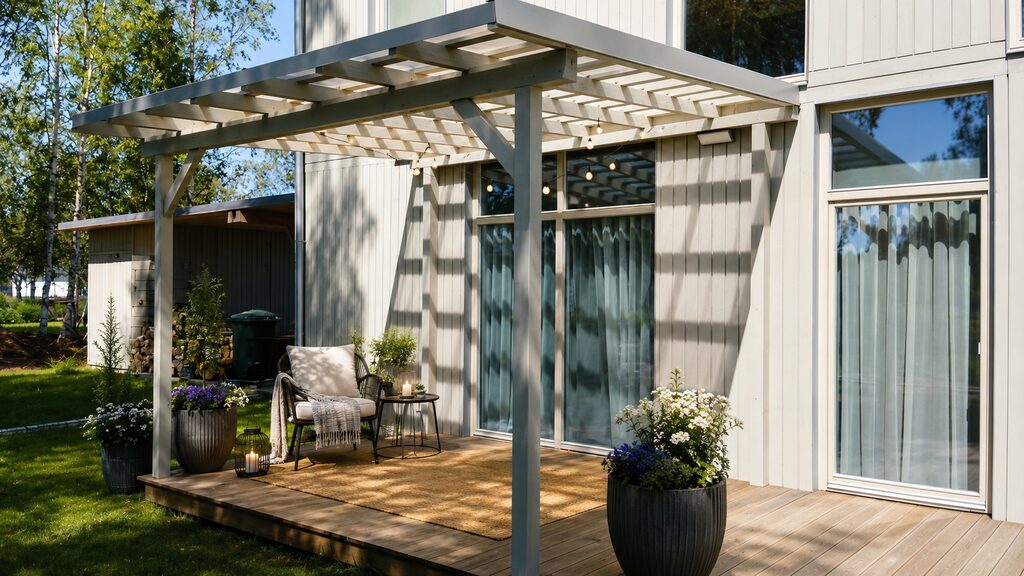
A wooden canopy with a polycarbonate roof protects a terrace from rain but keeps light in the house windows. In the catalogue a 3 x 4 m canopy by the house starts at €2,800 excluding VAT. It is the simplest way to use a terrace on a rainy day too.
A canopy by the house is a roof on wooden posts over a terrace or an entrance. It has no walls or only railings. If the canopy roof is polycarbonate, light stays under it and the house windows are not left in shade. That is why this solution is often chosen in front of living room or kitchen windows.
A canopy by the house is a roof on wooden posts over a terrace or an entrance. A polycarbonate roof protects from rain but keeps light in the house windows. A canopy is simpler and usually cheaper than a veranda, but it gives less protection from wind. In the catalogue such structures start at €2,800 excluding VAT.
A canopy and a veranda are similar but not the same. A canopy is mainly a roof over an existing or new terrace. A veranda is usually a more complete space with a floor, railings and sometimes walls. A canopy is simpler and usually cheaper. A veranda gives more protection from wind.
If the main aim is to protect the terrace from rain and to sit outside on a cloudy day too, a canopy is often enough. If a place to sit in windy weather is needed, it is better to plan a veranda with side walls. There is also an article on this choice, open or glazed veranda.
The catalogue has several wooden structures with a polycarbonate roof.
Prices are shown excluding VAT.
All the examples are in the section polycarbonate extensions for houses.
Clear polycarbonate lets a lot of light through. On a sunny summer day it can get warm under it. Matt or tinted polycarbonate diffuses the light and gives softer shade. The choice depends on which way the terrace faces. On the south side a tinted sheet is often chosen, on the north side a clear one.
The size of the canopy depends on the terrace and on what will stand under it. A table with chairs needs room for the chairs to be pushed back. If a grill will stand under the canopy too, a safe distance to the roof and ventilation have to be considered. A canopy against the house wall most often has a mono-pitch roof that leads water away from the house.
A polycarbonate roof is cleaned with water and a soft sponge. Leaves and twigs are best cleared from the roof regularly, because they show clearly on a clear roof. The wooden posts and beams are looked after like any other wooden surface. More on this in the article wooden veranda care.
A canopy built against the house wall changes the volume of the house just like a veranda. A free-standing canopy in the garden is an auxiliary building with different rules. Which documents are needed is explained in the article does an extension need a building permit, but the precise answer comes from the local building authority.
One edge of a canopy by the house usually sits against the house wall, while wooden posts carry the other. The roof slopes away from the house so that water runs into the gutter. The place where the canopy meets the wall must be watertight. How the connection is made depends on the house wall and the roof height, so a craftsman assesses it on site.
A canopy can stand over an existing terrace or over a new wooden floor. If there is already a terrace, it is checked for being level and for suitable spots for the posts. If there is no terrace, a wooden floor can be made together with the canopy, and both parts then form one structure.
Rain on polycarbonate can be heard. A shingle roof is quieter in the rain.
Often they can, if the posts and roof allow it. This is best agreed when ordering.
Yes. Several catalogue projects have a wooden floor under the roof. Choosing a terrace is covered in the article what terrace to choose for a wooden veranda.
The service life depends on the type of sheet and the manufacturer. Precise information is in the manufacturer's description of the material.
Yes. The catalogue has examples next to different houses. The fixings are chosen according to the wall material.
A grill needs a safe distance to the roof and good air flow. Polycarbonate and wood do not withstand heat, so a grill is better placed at the edge of the canopy or outside it. The exact requirements are in the grill manufacturer's instructions.
We usually reply within an hour on working days.
We use cookies to understand how the site is used. They are only switched on with your consent.