A wooden veranda lasts longer if it is checked and cleaned twice a year and its surface treatment is renewed in time. Most of the work is simple and takes one day off in spring and one in autumn.
Wood is a natural material. Sun, rain and frost change it little by little. Good care is not complicated, but it has to be regular. This article sums up the jobs for spring and autumn and how to choose between oil and paint.
A wooden veranda is checked and cleaned twice a year, and the oil or paint is renewed when needed. The most important thing is that water runs off the roof and floor and that air can move under the floor. For renewal the same or a compatible product as before is chosen, and the manufacturer's instructions are followed.
After winter it is worth walking round the veranda and looking at the main points.
Small faults are easier to repair straight away. If the foundations have settled or the structure has tilted, it is better to contact a craftsman.
The floor is swept first. Then it is washed with water and a soft brush, if needed with a cleaner made for wooden surfaces. A pressure washer on high pressure can tear the wood fibres, so it is used with care or not at all. After washing the wood must dry well before it is oiled or painted.
A greenish film can appear on the wood in shady places. It is removed with a product made for wooden surfaces according to the manufacturer's instructions.
Oil or opaque paint is usually used on the surfaces of a wooden veranda.
Decking oil soaks into the wood and keeps the grain visible. An oiled surface is easy to renew, because the old layer does not have to be removed. On a floor that is walked on a lot, oil has to be renewed more often than on the walls or the roof structure.
Opaque paint gives an even coloured surface and covers the wood well. It lasts longer between renewals, but once it starts to peel, the loose paint must be removed before a new coat.
The most important rule is not to mix different products without testing. If the veranda was oiled, it is kept oiled with a compatible oil. If it was painted, it is kept painted. How often to renew the treatment is set by the manufacturer of the product, and the instructions are on the can.
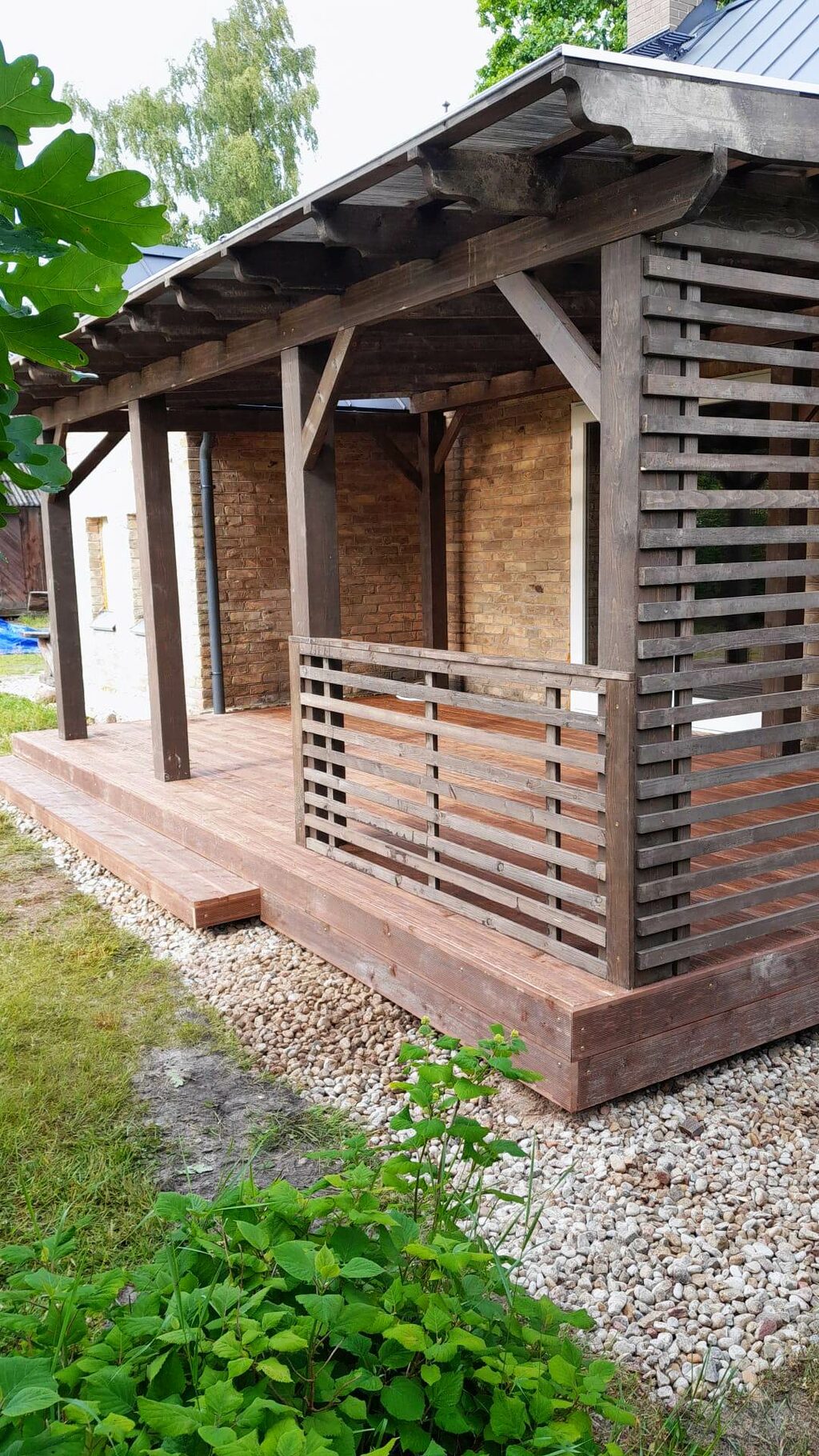
The veranda parts are prepared, treated and stained in the workshop before installation. After installation it is worth finding out which product the wood was treated with. The same or a compatible product in the same shade can then be chosen for renewal.
Leaves and twigs should be cleared from the roof at least in autumn. A polycarbonate roof is washed with water and a soft sponge, because hard brushes can scratch the surface. Leaves and moss should be cleared from a shingle roof in good time. Gutters must be clean, so that water does not run onto the veranda floor and the house wall. The different roof coverings are covered in the article roof covering for a veranda.
If the floor has become soft, the structure is tilted or damp has appeared on the house wall, the problem may lie in the foundations or the connection. It is then better to consult the maker. Foundations and their role are covered in the article foundations for a veranda and extension. A new veranda is described on the page how to order a wooden extension.
Oil and paint are applied in dry weather, when the wood is dry and the air temperature meets the manufacturer's instructions. Plants and windows are covered before the work. After treatment the floor must be left to dry before furniture is put back on it.
That depends on how the parts were treated in the workshop. It is better to ask the maker when and with what to do the first renewal.
Usually it is enough for the floor to be clean and for water to run off it. A cover that traps moisture can do more harm than good.
Untreated wood slowly turns grey in the sun. It can be cleaned with a product made for wooden surfaces and then oiled or painted again.
We usually reply within an hour on working days.
We use cookies to understand how the site is used. They are only switched on with your consent.